
Multiple Regression
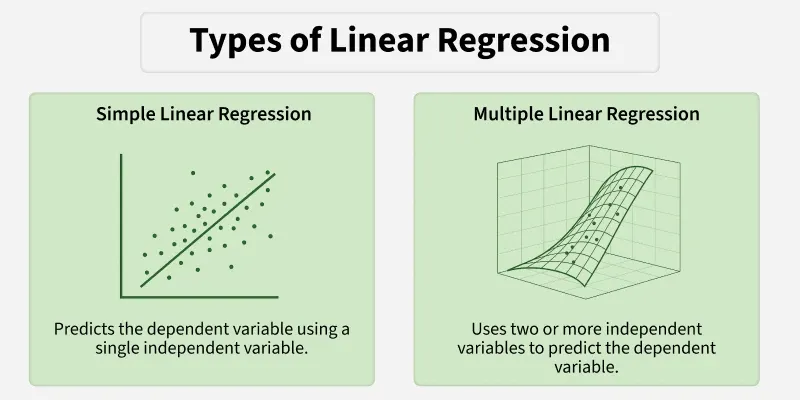
Multiple regression is like linear regression, but with more than one independent value, meaning that we try to predict a value based on two or more variables.
Linear regression is a statistical method used for predictive analysis. It models the relationship between a dependent variable and a single independent variable by fitting a linear equation to the data. Multiple Linear Regression extends this concept by modelling the relationship between a dependent variable and two or more independent variables. This technique allows us to understand how multiple features collectively affect the outcomes
Take a look at the data set below, it contains some information about cars.
| Car | Model | Volume | Weight | CO2 |
|---|---|---|---|---|
| Toyota | Aygo | 1000 | 790 | 99 |
| Mitsubishi | Space Star | 1200 | 1160 | 95 |
| Skoda | Citigo | 1000 | 929 | 95 |
| Fiat | 500 | 900 | 865 | 90 |
| Mini | Cooper | 1500 | 1140 | 105 |
We can predict the CO2 emission of a car based on the size of the engine, but with multiple regression we can throw in more variables, like the weight of the car, to make the prediction more accurate.
How Does It Work?
In Python we have modules that will do the work for us. Start by importing the Pandas module. The Pandas module allows us to read csv files and return a DataFrame object.
import pandasLearn about the Pandas module in our Pandas Tutorial.
The Pandas module allows us to read csv files and return a DataFrame object.
The file is meant for testing purposes only, you can download it here:data.csv
df = pandas.read_csv("data.csv")Then make a list of the independent values and call this variable X.
Put the dependent values in a variable called y.
X = df[['Weight', 'Volume']]
y = df['CO2']
Tip: It is common to name the list of independent values with a upper case X, and the list of dependent values with a lower case y.
We will use some methods from the sklearn module, so we will have to import that module as well:
from sklearn import linear_modelFrom the sklearn module we will use the LinearRegression() method to create a linear regression object.
This object has a method called fit() that takes the independent and dependent values as parameters and fills the regression object with data that describes the relationship:
regr = linear_model.LinearRegression()
regr.fit(X, y)
Now we have a regression object that are ready to predict CO2 values based on a car's weight and volume:
#predict the CO2 emission of a car where the weight is 2300kg, and the volume is 1300cm³:
predictedCO2 = regr.predict([[2300, 1300]])
Example
Copy the example from below, but change the weight from 2300 to 3300:
import pandas
from sklearn import linear_model

df = pandas.read_csv("data.csv")

X = df[['Weight', 'Volume']]
y = df['CO2']

regr = linear_model.LinearRegression()
regr.fit(X, y)

#predict the CO2 emission of a car where the weight is 2300kg, and the volume is 1300cm3:
predictedCO2 = regr.predict([[2300, 1300]])

print(predictedCO2)
Result:
[114.75968007]Coefficient
The coefficient is a factor that describes the relationship with an unknown variable.
Example: if x is a variable, then 2x is x two times. x is the unknown variable, and the number 2 is the coefficient.
In this case, we can ask for the coefficient value of weight against CO2, and for volume against CO2. The answer(s) we get tells us what would happen if we increase, or decrease, one of the independent values.
Example
Print the coefficient values of the regression object:
import pandas
from sklearn import linear_model

df = pandas.read_csv("data.csv")

X = df[['Weight', 'Volume']]
y = df['CO2']

regr = linear_model.LinearRegression()
regr.fit(X, y)

print(regr.coef_)
Result:
[0.00755095 0.00780526]Result Explained
The result array represents the coefficient values of weight and volume.
Weight: 0.00755095
Volume: 0.00780526
These values tell us that if the weight increase by 1kg, the CO2 emission increases by 0.00755095g.
And if the engine size (Volume) increases by 1cm³, the CO2 emission increases by 0.00780526g.
I think that is a fair guess, but let test it!
We have already predicted that if a car with a 1300cm³ engine weighs 2300kg, the CO2 emission will be approximately 107g.
What if we increase the weight with 1000kg?
Example
Copy the example from before, but change the weight from 2300 to 3300:
import pandas
from sklearn import linear_model

df = pandas.read_csv("data.csv")

X = df[['Weight', 'Volume']]
y = df['CO2']

regr = linear_model.LinearRegression()
regr.fit(X, y)

predictedCO2 = regr.predict([[3300, 1300]])

print(predictedCO2)
Result:
[114.75968007]We have predicted that a car with a 1.3 liter engine, and a weight of 3300 kg, will release approximately 115 grams of CO2 for every kilometer it drives.
Which shows that the coefficient of 0.00755095 is correct:
107.2087328 + (1000 * 0.00755095) = 114.75968