
What Is The Machine Learning
Machine learning (ML) allows computers to learn and make decisions without being explicitly programmed. It involves feeding data into algorithms to identify patterns and make predictions on new data. It is used in various applications like image recognition, speech processing, language translation, recommender systems, etc. In this article, we will see more about ML and its core concepts.
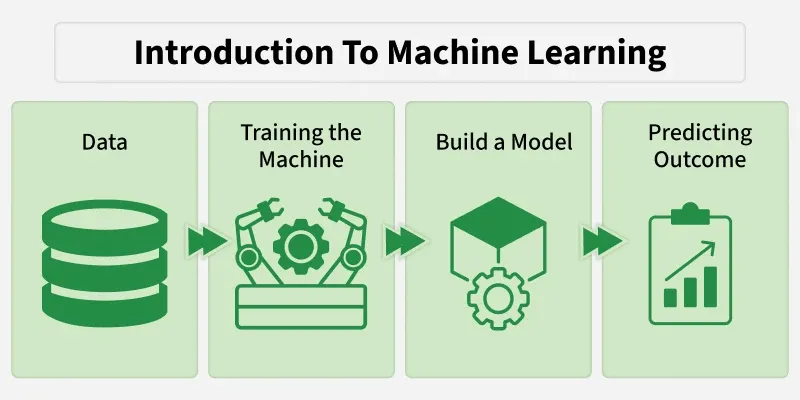
Machine Learning is making the computer learn from studying data and statistics.
Machine Learning is a step into the direction of artificial intelligence (AI).
Machine Learning is a program that analyses data and learns to predict the outcome.
Why do we need Machine Learning?
Traditional programming requires exact instructions and doesn’t handle complex tasks like understanding images or language well. It can’t efficiently process large amounts of data. Machine Learning solves these problems by learning from examples and making predictions without fixed rules. Let's see various reasons why it is important:
What Makes a Machine "Learn"?
A machine "learns" by identifying patterns in data and improving its ability to perform specific tasks without being explicitly programmed for every scenario. This learning process helps machines to make accurate predictions or decisions based on the information they receive. Unlike traditional programming where instructions are fixed, ML allows models to adapt and improve through experience.
Types of Machine Learning
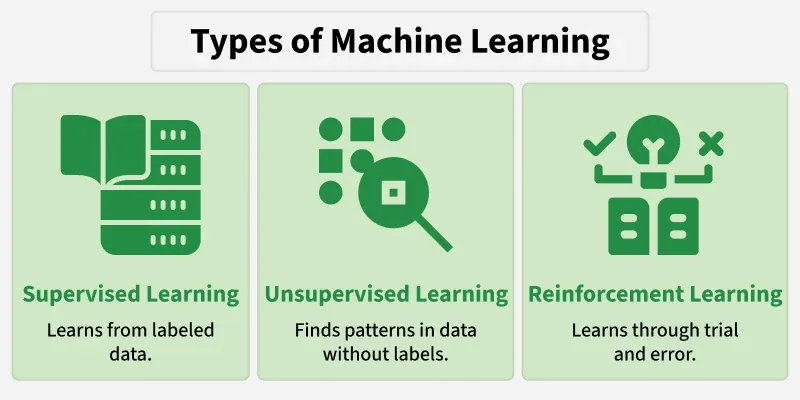
There are three main types of machine learning which are as follows:
1. Supervised learning
Supervised learning trains a model using labeled data where each input has a known correct output. The model learns by comparing its predictions with these correct answers and improves over time. It is used for both classification and regression problems.
2. Unsupervised learning:
Unsupervised learning works with unlabeled data where no correct answers or categories are provided. The model's job is to find the data, hidden patterns, similarities or groups on its own. This is useful in scenarios where labeling data is difficult or impossible. Common applications are clustering and association.
3. Reinforcement Learning
Reinforcement Learning (RL) trains an agent to make decisions by interacting with an environment. Instead of being told the correct answers, agent learns by trial and error method and gets rewards for good actions and penalties for bad ones. Over time it develops a strategy to maximize rewards and achieve goals. This approach is good for problems having sequential decision making such as robotics, gaming and autonomous systems.
Where To Start?
In this tutorial we will go back to mathematics and study statistics, and how to calculate important numbers based on data sets.
We will also learn how to use various Python modules to get the answers we need.
And we will learn how to make functions that are able to predict the outcome based on what we have learned.
Data Set
In the mind of a computer, a data set is any collection of data. It can be anything from an array to a complete database.
Example of an array:
[99,86,87,88,111,86,103,87,94,78,77,85,86]Example of a database:
| Carname | Color | Age | Speed | AutoPass |
|---|---|---|---|---|
| BMW | red | 5 | 99 | Y |
| Volvo | black | 7 | 86 | Y |
| VW | gray | 8 | 87 | N |
| VW | white | 7 | 88 | Y |
| Ford | white | 2 | 111 | Y |
| VW | white | 17 | 86 | Y |
| Tesla | red | 2 | 103 | Y |
| BMW | black | 9 | 87 | Y |
| Volvo | gray | 4 | 94 | N |
| Ford | white | 11 | 78 | N |
| Toyota | gray | 12 | 77 | N |
| VW | white | 9 | 85 | N |
| Toyota | blue | 6 | 86 | Y |
By looking at the array, we can guess that the average value is probably around 80 or 90, and we are also able to determine the highest value and the lowest value, but what else can we do?
And by looking at the database we can see that the most popular color is white, and the oldest car is 17 years, but what if we could predict if a car had an AutoPass, just by looking at the other values?
That is what Machine Learning is for! Analyzing data and predicting the outcome!
Data Types
To analyze data, it is important to know what type of data we are dealing with.
We can split the data types into three main categories:
- Numerical
- Categorical
- Ordinal
Numerical data are numbers, and can be split into two numerical categories:
- Discrete Data- counted data that are limited to integers. Example: The number of cars passing by.
- Continuous Data- measured data that can be any number. Example: The price of an item, or the size of an item.
Categorical data are values that cannot be measured up against each other. Example: a color value, or any yes/no values.
Ordinal data are like categorical data, but can be measured up against each other. Example: school grades where A is better than B and so on.
By knowing the data type of your data source, you will be able to know what technique to use when analyzing them.
You will learn more about statistics and analyzing data in the next chapters.