Machine Learning - Cross Validation
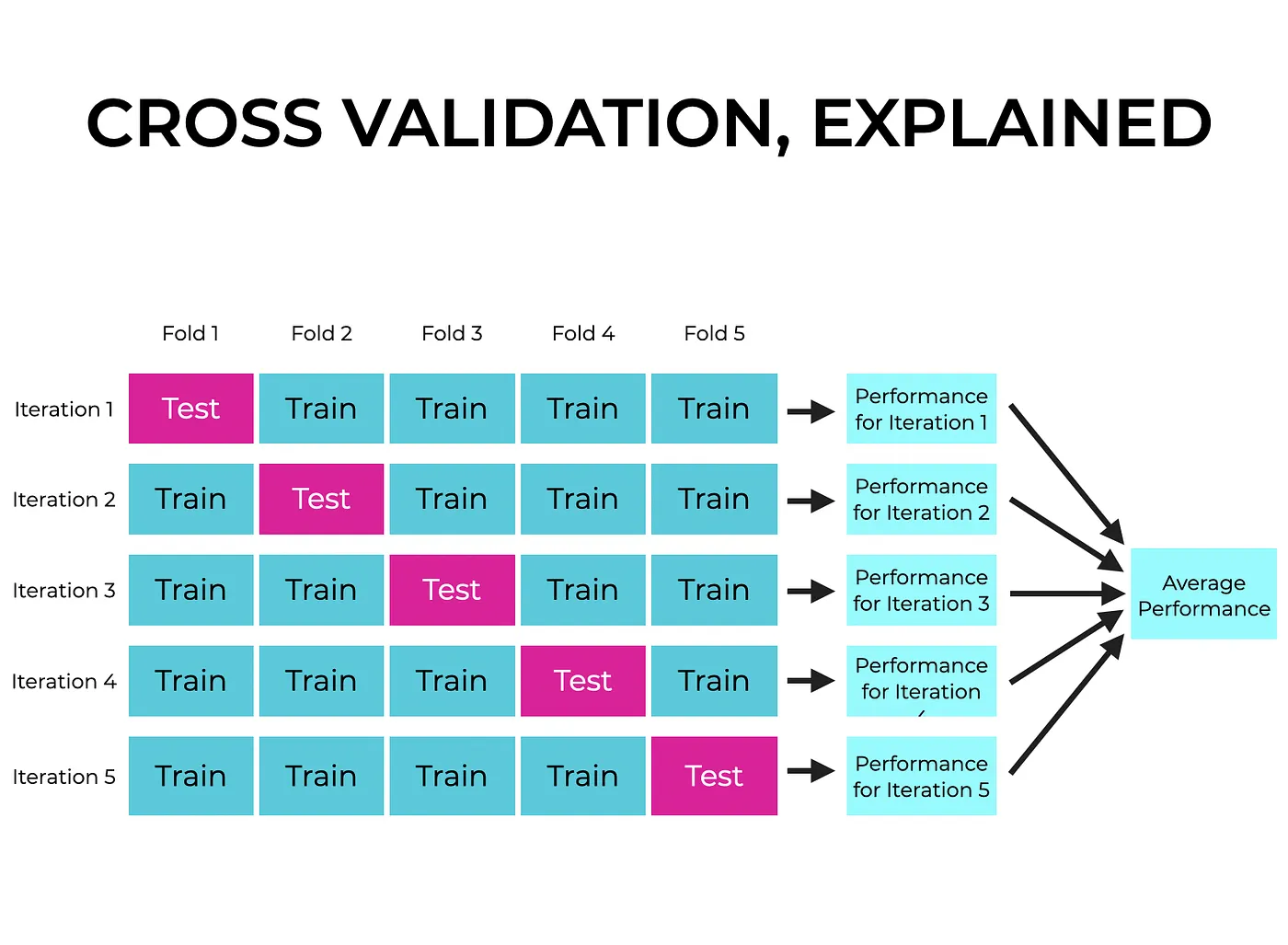
Cross-validation is a technique used to check how well a machine learning model performs on unseen data while preventing overfitting. It works by:
When adjusting models we are aiming to increase overall model performance on unseen data. Hyperparameter tuning can lead to much better performance on test sets. However, optimizing parameters to the test set can lead information leakage causing the model to perform worse on unseen data. To correct for this we can perform cross validation. To better understand CV, we will be performing different methods on the iris dataset. Let us first load in and separate the data.
from sklearn import datasets

X, y = datasets.load_iris(return_X_y=True)
Types of Cross-Validation
There are several types of cross-validation techniques which are as follows:
Holdout Method
In Holdout Validation method typically 50% data is used for training and 50% for testing. Making it simple and quick to apply. The major drawback of this method is that only 50% data is used for training, the model may miss important patterns in the other half which leads to high bias.
2. LOOCV (Leave One Out Cross Validation)
In this method the model is trained on the entire dataset except for one data point which is used for testing. This process is repeated for each data point in the dataset. All data points are used for training, resulting in low bias.Testing on a single data point can cause high variance, especially if the point is an outlier. It can be very time-consuming for large datasets as it requires one iteration per data point.
3. Stratified Cross-Validation
It is a technique that ensures each fold of the cross-validation process has the same class distribution as the full dataset. This is useful for imbalanced datasets where some classes are underrepresented.
The dataset is divided into k folds, keeping class proportions consistent in each fold each iteration, one fold is used for testing and the remaining folds for training. This process is repeated k times so that each fold is used once as the test set. It helps classification models generalize better by maintaining balanced class representation.
K-Fold
The training data used in the model is split, into k number of smaller sets, to be used to validate the model. The model is then trained on k-1 folds of training set. The remaining fold is then used as a validation set to evaluate the model.
As we will be trying to classify different species of iris flowers we will need to import a classifier model, for this exercise we will be using a DecisionTreeClassifier. We will also need to import CV modules from sklearn.
from sklearn.tree import DecisionTreeClassifier
from sklearn.model_selection import KFold, cross_val_score

clf = DecisionTreeClassifier(random_state=42)

k_folds = KFold(n_splits = 5)

scores = cross_val_score(clf, X, y, cv = k_folds)

print("Cross Validation Scores: ", scores)
print("Average CV Score: ", scores.mean())
print("Number of CV Scores used in Average: ", len(scores))
Stratified K-Fold
In cases where classes are imbalanced we need a way to account for the imbalance in both the train and validation sets. To do so we can stratify the target classes, meaning that both sets will have an equal proportion of all classes.
from sklearn.model_selection import StratifiedKFold, cross_val_score

sk_folds = StratifiedKFold(n_splits = 5)

scores = cross_val_score(clf, X, y, cv = sk_folds)

print("Cross Validation Scores: ", scores)
print("Average CV Score: ", scores.mean())
print("Number of CV Scores used in Average: ", len(scores))
Leave-One-Out (LOO)
Instead of selecting the number of splits in the training data set like k-fold LeaveOneOut, utilize 1 observation to validate and n-1 observations to train. This method is an exhaustive technique.
from sklearn.model_selection import LeaveOneOut, cross_val_score

loo = LeaveOneOut()

scores = cross_val_score(clf, X, y, cv = loo)

print("Cross Validation Scores: ", scores)
print("Average CV Score: ", scores.mean())
print("Number of CV Scores used in Average: ", len(scores))
Leave-P-Out (LPO)
Leave-P-Out is simply a nuanced difference to the Leave-One-Out idea, in that we can select the number of p to use in our validation set.
from sklearn.model_selection import LeavePOut, cross_val_score

lpo = LeavePOut(p=2)

scores = cross_val_score(clf, X, y, cv = lpo)

print("Cross Validation Scores: ", scores)
print("Average CV Score: ", scores.mean())
print("Number of CV Scores used in Average: ", len(scores))
Shuffle Split
Unlike KFold, ShuffleSplit leaves out a percentage of the data, not to be used in the train or validation sets. To do so we must decide what the train and test sizes are, as well as the number of splits.
from sklearn.model_selection import ShuffleSplit, cross_val_score

ss = ShuffleSplit(train_size=0.6, test_size=0.3, n_splits = 5)

scores = cross_val_score(clf, X, y, cv = ss)

print("Cross Validation Scores: ", scores)
print("Average CV Score: ", scores.mean())
print("Number of CV Scores used in Average: ", len(scores))