Algebra for Data Science and Machine Learning
By Admin | 24 November 2024
Table of Contents
- Introduction
- What is Algebra?
- Why is Algebra Important?
- How to Approach Algebra?
- Breaking it Down
- Components of Algebra
- Applications of Algebra in Data Science
- Algebra and types
- History of Algebra
- Conclusion
Introduction
Welcome to the comprehensive guide on "Algebra for Data Science and Machine Learning"! In this course, we will embark on a fascinating journey to explore the fundamental concepts of algebra and their profound applications in the dynamic fields of data science and machine learning.
What is Algebra?
Algebra is a branch of mathematics that uses symbols and letters to represent numbers and quantities in equations and formulas. It provides a powerful framework for solving problems, modeling relationships, and making predictions.
The term "algebra" comes from the Arabic word "al-jabr", which means "reunion of broken parts" or "bonesetting". This aptly describes how algebra brings together various mathematical concepts to solve complex problems.
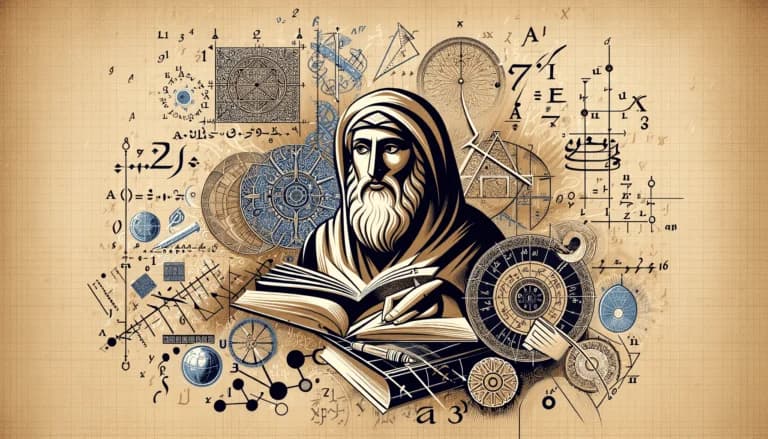
You'll gain a deep understanding of algebraic principles and their practical implications. This course is designed to equip you with the mathematical tools necessary to excel in data-driven disciplines.
Request a Demo
Want to see how our courses can benefit you? Request a free demo and explore our learning platform.
Why is Algebra Important?
Algebra is crucial for data science and machine learning because it provides the foundational mathematical language and tools for:
- Modeling Data: Representing complex relationships and patterns in data.
- Algorithm Development: Designing and implementing machine learning algorithms.
- Optimization: Finding the best solutions to problems by minimizing errors or maximizing performance.
- Interpretation: Understanding the underlying principles and results of data analysis.
How to Approach Algebra?
To effectively learn algebra for data science, we recommend a structured approach:
- Master the Basics: Ensure a strong understanding of fundamental concepts like variables, equations, and functions.
- Focus on Applications: Connect algebraic concepts to real-world data science problems.
- Practice Regularly: Solve numerous problems to reinforce your understanding and build problem-solving skills.
- Utilize Resources: Leverage textbooks, online tutorials, and practice exercises.
Breaking it Down
This course breaks down complex algebraic topics into manageable modules, making it accessible for learners of all backgrounds. Each module includes clear explanations, examples, and practice exercises to solidify your understanding.
Components of Algebra
| Component | Definition | Example |
|---|---|---|
| Variables | Symbols (usually letters) representing unknown quantities. | x, y, z, a, b, c |
| Expressions | Combinations of variables, numbers, and operations. | $2x + 5$, $3y - 7$ |
| Equations | Mathematical statements showing two expressions are equal. | $2x + 5 = 11$ |
| Inequalities | Mathematical statements showing one expression is greater than or less than another. | $3y - 7 < 8$ |
| Functions | Relationships where each input has exactly one output. | $f(x) = x^2 + 2x - 1$ |
| Polynomials | Expressions consisting of variables and coefficients, involving only addition, subtraction, multiplication, and non-negative integer exponents of variables. | $x^3 + 2x^2 - 5x + 7$ |
| Linear Algebra | Branch of algebra dealing with vectors, vector spaces, linear transformations, and systems of linear equations. | Matrix operations, eigenvalues |
| Boolean Algebra | A branch of algebra in which the values of the variables are the truth values, true and false, usually denoted 1 and 0 respectively. | Logic gates, set theory |
Applications of Algebra in Data Science
Algebra plays a pivotal role in various data science and machine learning applications:
- Vector and Matrix Operations: Essential for representing and manipulating data, especially in machine learning algorithms like neural networks and principal component analysis (PCA).Learn more about matrices
- Linear Regression: Used to model the linear relationship between a dependent variable and one or more independent variables. Algebraic equations are fundamental to this process.
- Machine Learning Algorithms: Many algorithms, including support vector machines (SVMs), decision trees, and clustering algorithms, rely heavily on algebraic principles for their underlying mechanics.Explore machine learning algorithms
- Dimensionality Reduction: Techniques like PCA and Singular Value Decomposition (SVD) use linear algebra to reduce the number of features in a dataset while preserving important information.
- Eigenvalues and Eigenvectors: Crucial in PCA, spectral clustering, and understanding the stability of systems.
- Algorithm Efficiency: Algebraic expressions are used to analyze the time and space complexity of algorithms, which is essential for optimizing performance.
- Deep Learning: The backbone of deep learning, involving complex matrix multiplications and vector operations in neural networks.
- Natural Language Processing (NLP): Used in techniques like word embeddings, topic modeling, and sentiment analysis, where text data is transformed into numerical representations.
- Clustering and Classification: Algebraic methods are used to group similar data points (clustering) and categorize data into predefined classes (classification).
- Image Recognition: Image processing and computer vision tasks involve extensive use of linear algebra for transformations, filtering, and feature extraction.
Algebra and types
| Type of Algebra | Description | Example |
|---|---|---|
| Elementary Algebra | Deals with basic algebraic operations and solving equations. | $x + 5 = 10$ |
| Abstract Algebra | Studies algebraic structures such as groups, rings, and fields. | Group theory, ring theory |
| Linear Algebra | Focuses on vectors, matrices, and linear transformations. | Matrix multiplication, eigenvalues |
| Boolean Algebra | Deals with logical operations (AND, OR, NOT) and binary values. | Digital circuits, set operations |
| Universal Algebra | Studies algebraic structures in a general sense, independent of specific operations. | Lattice theory |
| Relational Algebra | A procedural query language for relational databases. | SQL queries |
| Homological Algebra | Studies homology in general algebraic settings. | Algebraic topology |
Algebra 1
Algebra 1 is typically the first high school mathematics course in the United States and introduces students to the fundamental concepts of algebra. It builds upon arithmetic and prepares students for more advanced mathematics courses.
- Key Topics: Variables, expressions, equations, inequalities, functions, graphing, systems of equations, and polynomials.
- Problem-Solving: Emphasizes developing logical reasoning and problem-solving skills.
- Real-World Applications: Connects algebraic concepts to everyday situations and various disciplines.
- Foundation: Serves as a crucial foundation for higher-level mathematics.
Algebra 2
Algebra 2 builds upon the concepts introduced in Algebra 1, delving into more complex topics and expanding students' mathematical toolkit. It often includes advanced functions, logarithms, and an introduction to trigonometry and probability.
- Key Topics: Quadratic functions, polynomial functions, rational functions, exponential and logarithmic functions, sequences and series, probability, and statistics.
- Advanced Functions: Exploring various types of functions and their properties.
- Problem-Solving: Tackling more intricate problems requiring deeper algebraic understanding.
- Preparation for Calculus: Provides essential groundwork for calculus and other advanced mathematics courses.
History of Algebra
The history of algebra is a fascinating journey, spanning millennia and cultures.
Ancient Origins (around 1900 BC)
Early algebraic ideas can be traced back to ancient Babylonian mathematics, which developed methods for solving linear and quadratic equations.
Egyptian Algebra (1650 BC)
The Rhind Papyrus, an ancient Egyptian mathematical text, contains problems that involve algebraic thinking to solve practical issues.
Islamic Golden Age (8th-13th Century AD)
The term "algebra" is derived from the Arabic word "al-jabr," which means "reunion of broken parts." This period saw significant advancements, particularly with the work of Muhammad ibn Musa al-Khwarizmi, whose book "The Compendious Book on Calculation by Completion and Balancing" laid the foundation for modern algebra.
Medieval Period (5th to 15th Century AD)
Algebraic concepts continued to evolve in various parts of the world, with contributions from Indian and Chinese mathematicians.
Renaissance (13th to 17th Century AD)
The Renaissance witnessed a resurgence of mathematical inquiry in Europe. Mathematicians like Fibonacci, Viète, and Descartes made significant contributions to the development of symbolic algebra and coordinate geometry.
Modern Era
The 18th, 19th, and 20th centuries saw further advancements, including the development of abstract algebra, linear algebra, and Boolean algebra, which have profound implications for computer science and various scientific fields.
Key Historical Milestones in Algebra
| Period | Key Figures/Cultures | Contributions |
|---|---|---|
| 1900 BC | Babylonians | Solving linear and quadratic equations. |
| 1650 BC | Egyptians (Rhind Papyrus) | Practical algebraic problems. |
| 8th-13th Century AD | Islamic Scholars (al-Khwarizmi) | Formalization of algebra, "al-jabr" term. |
| 13th-17th Century AD | Renaissance (Fibonacci, Viète, Descartes) | Symbolic algebra, coordinate geometry. |
| Modern Era | Various mathematicians | Abstract algebra, linear algebra, Boolean algebra. |
Conclusion
In conclusion, algebra is a powerful and indispensable tool for data scientists and machine learning engineers. Its principles underpin many of the algorithms and techniques used to extract insights from data, build predictive models, and automate complex tasks. By mastering algebra, you unlock the ability to understand, implement, and innovate in the rapidly evolving world of data science.